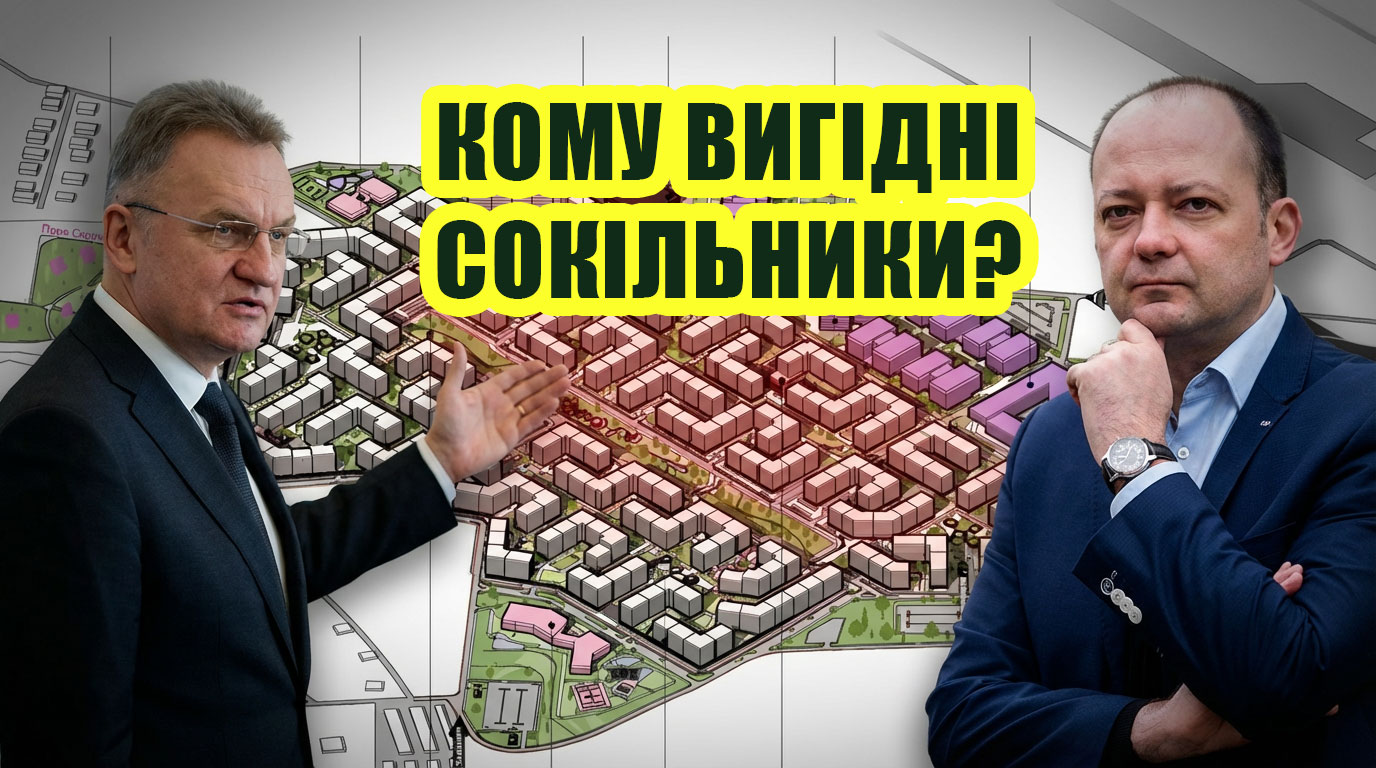
The story with the development of Sokolniki near the Lviv International Airport named after Daniil Galitsky is gradually moving beyond the urban planning discussion and into the plane of political and managerial responsibility.
During Lubomir Zubacz’s speech, the scale of the project, which had previously been discussed behind the scenes, was actually confirmed. We are talking about 72.2 hectares of land, on which Sokolnicki Village Council plans to build 847,495 square metres of housing. This is a full-fledged new housing estate to be located directly next to the airport.
At the same time, the press conference at which these positions were voiced was held without the participation of Sokolniki representatives. Formally open, it actually took place in a narrow circle of selective media. The party directly affected by this decision did not take part in the discussion.
The content of the speeches also leaves many questions. On the one hand, the representatives of the city authorities point out that residential development near the airport is a problem and poses a threat to the infrastructure. On the other hand, it is in this zone that a number of residential projects have already been implemented, and the development continues. In the transcript of the interview the list of residential complexes – “Familia”, “City of Trav”, “Quorum”, “Fly”, as well as commercial projects like Victoria Gardens – is explicitly mentioned. Some of these projects appeared after 2012, i.e. in the period when the issue of development of the airport and adjacent territories was well known.
The topic of political connections of the development is raised separately. The same discussion mentions the Viking Gardens project, which is linked to Oleg Lavrik, a representative of the same political environment. This creates a direct conflict between the public position on the “harmfulness” of housing in this zone and the actual participation of connected persons in the development.
The approach to powers is no less contradictory. When it comes to Sokolniki, the rhetoric includes the right of Lviv to influence the development of the territory. At the same time, when asked about alternatives, in particular the possibility of implementing similar projects in Stryi, the argument about the limited competence of the city council and the need to appeal to the regional authorities immediately appears. Such a change of position depending on the situation looks like selective use of powers.
The legal context in this story is also clearly delineated. The Supreme Court decision determined that Sokolniki is a separate territorial community that makes its own decisions regarding its territory. Moreover, some of the land is privately owned. Despite this, there is an attempt to shape the agenda for this community as well.
The interview itself captures another important detail – the logic of double standards in approaches to different territories. There is a direct question: why it is possible to transport rubbish from Lviv to Stryi, but it is not possible to consider Stryi as a site for infrastructure development. The answer actually boils down to redirecting responsibility to other authorities without any specific explanations.
The question of why areas on the Lviv side, which could have been used for logistics development or airport infrastructure, have been built up with housing and shopping centres remains unanswered. But now the focus is on the neighbouring community.
The speeches also regularly refer to “artificial obstacles”, “attempts at division” and “populism”. However, in none of the cases is it specified who exactly creates these obstacles and what they consist of. This allows for the formation of the desired narrative without factual detail.
At the same time, the city authorities are actively involved in the discussion about the development of the airport, which is a state-owned enterprise. At the same time, it is not explained on what grounds the Lviv City Council assumes the role of one of the key participants in this process, especially given the fact that we are talking about an object outside its direct competence.
As a result, the situation around Sokolniki looks like a combination of several parallel processes: large-scale residential development, political rhetoric about its undesirability, attempts to influence the neighbouring community and selective interpretation of authority depending on the context.